the links need to be of equal length so that the sway bar isn't pre-stressed.
while pre-stressing is not necessarily a bad thing, it just means that you won't get the same roll stiffness doing LH turns as you would doing RH turns (and vice versa).
they're also adjustable so that you can change the direction of force the end link is putting on the sway bar the moment you start getting body roll.
ideally, you want the link to be 90 degrees with the sway bar where it meets the sway bar bushings. it'll allow more torque to transfer from one end of the sway bar bushing to the next during cornering.
basically, it'll maximize the performance of the sway bar.
i made a diagram to show the angle i'm referring to.
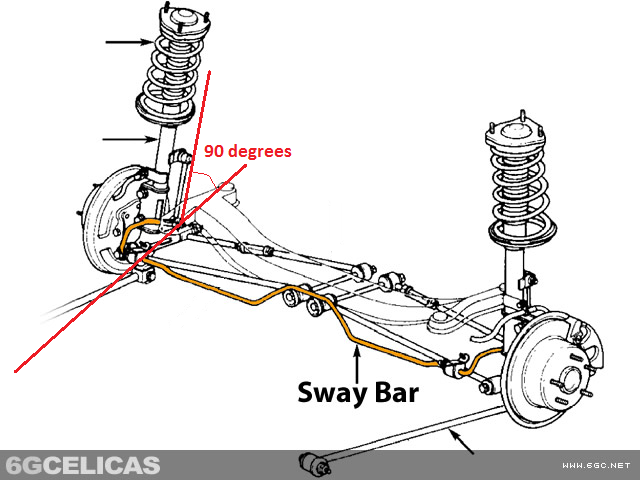
during auto-cross events where you're always cornering left and right & putting more cornering loads on the suspension, it'll be better to have it at a slightly higher angle.
for example, if at maximum cornering load the angle (in the picture) reaches a minimum of 86 degrees which is when the suspension achieves its highest length of travel giving you a maximum deflection angle of 4 degrees (90-86=4), then it would be better to have it set to around 92 degrees when static (90+4/2=92) so that deflection angles range between 88-92 degrees and always maximizing the anti-roll performance of your set-up.
This post has been edited by azian_advanced: Apr 23, 2012 - 10:11 AM

